

In, on or out of the loop: deciding what to hand to AI
Human in the loop, on the loop or out of the loop? Four questions for choosing how much to hand to AI, task by task.
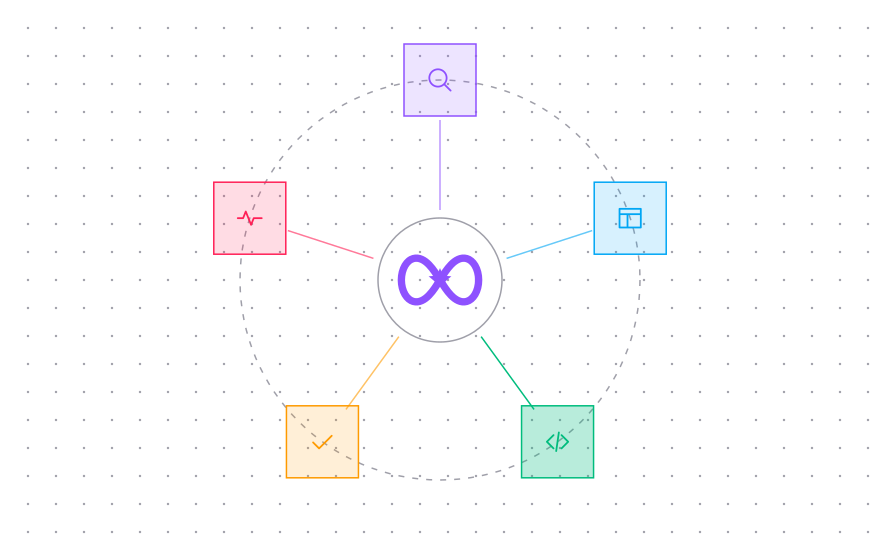
When an AI assistant can write code, run tests and fix failures on its own, the most practical question is not how good the AI is but where people should stand for each kind of work. We answer it with three familiar positions: human in the loop, human on the loop and human out of the loop. The vnLOOP logo, a loop with a star at its centre, comes from the same idea.
Human in the loop
In this position the AI cannot move on until a person approves. The AI prepares, analyses and proposes; a person decides at every checkpoint. This is the choice for work where mistakes are hard to undo or directly affect customers.
- Settling the scope and priorities of a project.
- Changing the architecture or the data model.
- Anything that touches customer data.
- Releasing to production.
The cost of this position is speed: everything waits for a person. That is why we only use it for work that truly deserves it.
Human on the loop
Here the AI completes the work on its own while a person supervises the results and steps in when something looks wrong. This is where most day-to-day development at vnLOOP sits: test-driven coding, reviewing changes, updating documentation. The AI moves fast, but every result leaves a trail for an engineer to check: the test that failed and then passed, the review report, the list of changed files.
The condition for working at this level is an objective signal that tells you whether the work is right. Test suites, type checkers, linters: the more automatic signals there are, the more a person can step back to supervise instead of doing each step.
Human out of the loop
The AI works fully on its own and people look at the log only when needed. We reserve this position for work that is safe and easy to reverse: formatting code, generating test data, regenerating images from source with a determinism check. If a task can cause damage that a log cannot undo, it does not belong here.
Choosing the position for a task
When a new task arrives, we answer four questions:
- If the AI gets it wrong, is it easy to reverse?
- Is there an automatic signal that tells right from wrong?
- Does it touch customer data, money or security?
- Does the decision need business context that only people have?
Reversible with an automatic signal means a person can be on or out of the loop. Touching data, money or security, or needing business context, means a person must be in the loop. A task can move over time: once the test suite is good enough, work that once needed step-by-step approval can move to supervision.
An example from our own work
When we designed the logos for vnLOOP's products, we used all three positions in a single project. Choosing ideas and approving each option was human in the loop: an AI assistant drew the options, a person decided. Producing every size, the light and dark versions and the files for each platform was human on the loop: the AI did the work while automated tests measured the space between strokes and how clearly each mark reads at small sizes. Regenerating every image from source was out of the loop, because a test guarantees the output is identical on every run.
The example shows that the line is not drawn by the kind of tool but by the consequence of a mistake and how easily it can be detected.
Common mistakes
- Putting people in the loop for everything: the AI saves no time and reviewers stop paying attention.
- Taking people out of the loop because the AI was right last time, without an automatic signal to catch the next mistake.
- Giving an AI assistant access it does not need, such as production data, when test data would do.
Each of these comes from treating autonomy as a setting for the AI rather than a property of the task. Decide per task, write the decision down, and revisit it as your checks improve.
Applying it to your product
This three-position framework is not only for how we build software. When we build AI features for clients, such as assistants that process documents or triage requests, we start with the same question: at which steps do your users need to approve, and at which can the AI act on its own? Answering it well is how AI becomes both useful and trustworthy.
Related posts
November 12, 2026
6 min read
Building software with AI: how we work at vnLOOP
AI drafts code, tests and reviews; people set the goals, approve the work and stay accountable. This is how we bring AI into everyday development without trading away quality.

November 7, 2026
4 min read
Building AI speaking practice: notes from LangExt
Why we are building LangExt, an app that turns your own material into personalised speaking practice for exams and interviews, and what we are learning.
November 4, 2026
4 min read
Automation for small teams: where to start
Small teams lose hours to repetitive work. Here is how we identify what to automate first, from bots and scrapers to data pipelines and AI features.